What's New at artisan & vine?

This blog site includes news on latest wines, food, events, offers and happenings at artisan & vine. It also includes stories of my wine adventures in and outside the bar, wine facts and wine profiles.

Showing posts with label Natural wine. Show all posts

Saturday, 10 July 2010

Kaitlyn and the Magic Bottles (or, Why I opened London’s first natural wine bar and shop)

[This story is a post I wrote for the 32 Natural Days of Wine series ]


Kaitlyn was lucky to live in a city where magic bottles were shipped in from places as far as Australia and as foreign as France. Although she was a curious girl, she'd left it until the very day on which this story begins to first taste wine. Kaitlyn knew from her dictionary that wine was “an alcoholic drink made from fermented grape juice”, which pleased her because it sounded like a healthy fruit-based way to consume alcohol.

Kaitlyn was curious but not rash and was nervous about spending too much money on something she might not like. So she bought three bottles of wine for £10 and went home. To her dismay the three bottles all tasted very much the same despite their different origins. “Why write the name of a place on a bottle if what is inside doesn’t give a sense of that place?” Kaitlyn wondered in frustration.

For thirty two times thirty two days following Kaitlyn drank only cocktails or alcho-pops – which also came in magic looking bottles – whenever she wanted a magic drink. At least these drinks described what flavours they were meant to have, rather than listing different countries or regions on a bottle while tasting very non-different inside.

One day more than that, Kaitlyn was walking down the street and up a hill when a terrible storm broke out. She ran for cover into what she quickly realised was another of these wine shops. “Oh drat and bother” she frowned.

The wall of the wine shop was lined with one hundred different bottles and on the counter sat two fishbowls. A silver herring swam around the fishbowl on the left and a red herring swam around the fishbowl on the right.

“But there’s no such thing as a red herring” Kaitlyn petitioned, wondering if the world of wine could seem any more implausible.
“There’s no such thing as talking herring either” the Silver Herring replied, “but here you have both”

The little wine shop Kaitlyn entered. Images of the herrings are absent because the talking herrings are not real.


“Would you like to try my wine?” cooed the Red Herring
“Or would you like to try my wine?” perked the Silver Herring
Kaitlyn yearned for a cocktail bar where good looking people rather than talking non-existent fish might serve her.
She looked at the bottles lined up behind the Silver Herring.
“Contadino?” questioned Kaitlyn, reading the label of an odd clear bottle with an even odder bright red liquid inside.
“It means ‘farmer’ in Italian” said the Silver Herring “It’s from a grape farm on the slopes of Mt Etna in Sicily”
Kaitlyn opened the bottle and took a drink of the Contadino.

Instantly Kaitlyn was transported to Mt Etna. She appeared to be in the grassy backyard of someone’s home. The sky was dark and the air had a slight chill to it. In front of her were nearly a dozen large plastic tubs with bright red grapes bobbing inside.

“Ciao!” beamed a bearded man with electric eyes, emerging from his home behind her “I’m Frank Cornelissen, welcome to my winery!”

I, Kathryn, stand in for Kaitlyn in photos with wine makers because she is not real. Here Frank Cornelissen shows me his fabulous grapes fermenting in giant plastic tubs.

“A winery?” questioned Kaitlyn, looking around the backyard.
“Yes! This is where we take those beautiful Mt Etna grapes and ferment them to create wine!” He scooped a wine glass into the vibrant plastic tub and handed it to Kaitlyn to taste, “Try some!”

Kaitlyn swished the wine around her mouth and tried to describe what she tasted, “intense red berry flavours, something minerally, like the wine was sprung from stone."
"Hardened magma to be precise" Frank smiled, “you taste that I’ve added nothing to the wine – this is 100% pure Mt Etna fruit”
It tasted delicious and not at all like those wines she’d had thirty two times thirty two days earlier.
Before she knew it, Kaitlyn had drunk all of the wine in her glass and was transported back to the wine shop.

Curiosity overcame confusion. She looked at the wines behind the Red Herring. Rather than describing a specific address or village, the Red Herring’s wines described large regions like ‘Central Valley’.

“Surely a wine made from a wider region must encompass even more flavours!” Kaitlyn remarked and eagerly took a drink from one of the Red Herring’s wines.

Again, she was instantly transported, this time, to what seemed like a factory. She gazed up at a massive steel tank that towered above her.


A winery I went to with tanks that dwarf people. This is not the worst thing that can happen to a person but dwarfing is not generally considered to be favourable.


"Where are we?" she asked the tidily dressed man standing beside her.
"In the winery" he replied, looking up from his clipboard.
Kaitlyn looked around her, seeking clues of where in the world she was. "Where are the grapes from?"
"All over” the winery man smiled proudly, "It doesn’t matter too much, we have the technology to acidify, de-acidify, chapetalise, micro-oxidise or extract as required."
Kaitlyn reflected on the dictionary definition of wine and her only other winery experience, “Don’t you only need to leave grapes bobbing in their juices to ferment and make wine?”
“Well you could – but that’s quite risky!” laughed the man, as if Kaitlyn had suggested something completely ludicrous, “Using modern technology we can produce consistent flavours, for a competitive price, on a mass-scale, year after year.”
Kaitlyn tasted the wine, “it tastes very woody”, she said hesitantly; confused about how something that comes from fruit, in a room full of steel, could taste like wood.
“Yes. For this wine we added tannin syrup and woodchips. This way we can make a very young wine taste like a great aged wine without the cost of oak aging or risky grape ripening.” The winery man explained enthusiastically.
Kaitlyn didn’t much like this additive-laden wine. She poured the drink out on to the sterile winery floor and was transported again back to the little wine shop.

She looked at the wines behind the Silver Herring and the Red Herring and blinked. There was nothing obvious to distinguish the two groups of wines.
“All wines are ‘made’, Kaitlyn. There is no wine plant, there are only grape vines.” Said the Silver Herring, “the difference is whether a wine tastes like it comes from somewhere or something.”
Kaitlyn felt betrayed and confused, “These manufactured wines seem to have more in common with my alcho-pops than fermented grape juice.”
“And they can be priced as good as alcho-pops too!” chirped the Red Herring
“I don’t know.” Kaitlyn said, remaining curious but not rash, “Let me try again”, Kaitlyn reached for another bottle behind the Silver Herring and took a sip.

Instantly she was transported to a beautiful sun kissed field. She could smell lavender and thyme and hear bees buzzing and birds singing. Ahead of her lay a vineyard, and beside it, a lovely two storey house, upon the balcony of which stood a man, singing out to his vines:
“I love you! I love you all!” he was saying to his vines. Kaitlyn walked to below the balcony.
“Bonjour!” the man gave a lively smile, “I’m Henri Milan, welcome to my beautiful vineyards of St Remy de Provence!”
Henri came downstairs and took her out amongst the vines. There were a wide range of colourful plants and insects living in the vineyard.


I stand in for Kaitlyn again, with Henri Milan, showing me is fantastically healthy biodynamic vineyard in Provence.

“The vines cannot live alone. They are part of an ecosystem, with lots of other plants and animals, they keep each other strong.” explained Henri “The flavour in the wines comes from the life in the vineyard and the soils. Because everything in the vineyard is natural, I make minimal intervention in the winery. What you taste is 100% Provencal fruit!”
Kaitlyn drank some more of Henri’s wine; “it tastes like lavender and thyme” she smiled contently.
“Of course – you are in Provence! These flavours are everywhere!” Henri exclaimed.
All too quickly Kaitlyn again had drunk all of the wine in her glass and was transported back to the little wine shop.

“It’s true! These magic bottles do have the potential to give a sense of the place that they’re from. But how do I find the magic wines from amongst these manufactured wines?” Kaitlyn questioned.

“The great dilemma of today’s wine world is not that there are so many ways of getting from fruit to wine but that the consumer has no reliable means of knowing which way a given wine maker has chosen” said the Silver Herring wisely.

Kaitlyn felt frustrated that all of the bottles in front of her were denying her the ability to make an informed choice about what she tasted and consumed. She turned scornfully to the Red Herring, “I do believe that your wines are as produced and preserved as an actual red herring and as distracting from the truth as the ideological red herring!”

She turned to the Silver Herring “The wines you’ve shown me…”
“We call them ‘natural wines’” interjected the Silver Herring helpfully.
“These natural wines are so very different to one another and so very like where they’re from. I do believe that each time I drink them I’m transported to where their grapes are grown.”

Kaitlyn felt resolve growing, “I may not have the ability to instantly change all bottle labelling to be more transparent, but I could help people find a lovely wine shop like this where there is transparency about what is being sold.”

The Silver Herring smiled, “There are no natural wine shops in our lucky city, but it needs only a beast with arms greater than a fish’s to open our first natural wine bar and shop.”

Kaitlyn looked down at her arms. They were a little lanky, but certainly capable of opening a shop “I could do it!” declared Kaitlyn excitedly, “But how will we let people to know that natural wine even exists as a choice?”

“32 days is a good start…”

Thursday, 8 July 2010

Natural wine definition

It’s occurred to me today that this is probably the only Natural wine blog site without a natural wine definition. This is partly because I find definitional debates, in general, too often rooted in pedantics and anecdotes when life seems to me to exist more organically in the realm of principle.

That said, as the home of London (indeed the UK's) first natural wine bar and shop, I feel obliged to define what exactly that means, at least my interpretation of it, which we are entirely transparent about thoughout our wine list and website.

At artisan & vine, all of our wines are either local (English) wines or natural (only the Davenport wines are both). “Natural wines” are not yet legally defined within the EU.

HERE'S MY SINGLE SENTENCE TAKE ON THE NATURAL WINE DEFINITION:

At artisan & vine, a natural wine is one made in a biodynamically or organically farmed vineyard, with indigenous (wild) yeasts, and minimal or no added sulphites or flavour enhancers.

The principle is to make wines that demonstrate a clear Sense of Place. They taste like they come from somewhere rather than something.

Why are organic wines not enough? Organic wines are not what they seem. Within the EU, a certified “organic wine” only guarantees you organically grown grapes; the winemaker may add flavours (such as wood chips or caramel), stabilisers (such as sulphur dioxide), and preservatives during the wine making production. This is how mass produced cheaper wines can be created.

Natural wines are wines created with minimal intervention from the wine maker. Natural wine making requires the artisan to carefully attend to all steps of the growing, fermenting, and blending processes, knowing that additives cannot be used to correct the imperfections of nature. As Tim Atkin MW concluded in his May 2010 article in The Times, “Natural wines are the opposite of mass-produced wines, of “spoofulated”, personality-free beverages that could come from almost anywhere. These are hand-crafted products”. Often this makes natural wines commercially unviable on a mass, low cost scale. Vintages can vary significantly from year to year based on climate conditions, and personal attention means very low yielding vineyards. I reckon you’ll taste this difference.

Image: Pierre Breton's fantastically healthy natural vineyards in Bourgueil, Loire Valley.

Tuesday, 22 June 2010

A visit to Davenport Vineyards, Kent

All of the wines at artisan & vine are either Local (English) or Natural. A natural wine is one that not only uses organic or biodynamic practices in the vineyard, but also uses minimal intervention in the winery. Most English vineyards are very low intervention but they are rarely organic and rarely ferment using wild yeasts indigenous to the grapes harvested. It’s a relatively minor point of distinction but it has factions of the wine world hot in debate. For me, the most important element is transparency: as consumers we should know what exactly is in our bottle of wine. Sadly, obtuse bottle labeling means that often we don’t.

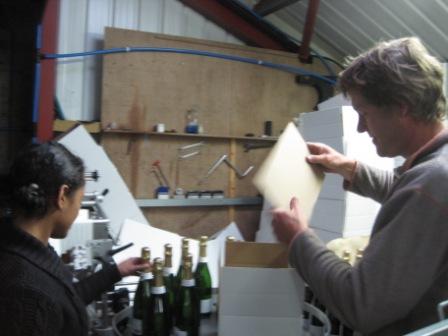
Of the 100 wines on the artisan & vine wine list only one is both Local and Natural. This is the Limney Sparkling wine from Will Davenport. Ideally I would have two wines on the list but as usual, Mr Davenport is completely sold out of his outstanding still white wine… back in stock and on our lists in a few weeks (I hope!) His wines are in such hot demand that when the artisan & vine team and I went to visit his gorgeous vineyards in Kent last week, we had to help label bottles ourselves just to get them on the shelves!

Will makes two sparkling wines, a white and a red. He has two vineyard sites over Kent and Sussex. The wine is delicious – absolutely worth coming by for a try! The still white wine in particular is extremely exciting for the overtly local AND natural qualities it displays.

Image: courageous English wine maker Will Davenport risked organic farming in wet England and has succeeded. Here he shows our Karlee how to pack wines for us to take home and put on the shelf!

Thursday, 17 June 2010

Randall Grahm quotes from his visit to artisan & vine

On Monday 7 June, we had a wine superstar at artisan & vine, Randall Grahm, owner and wine maker of Bonny Doon Vineyards in California.

I've been asked several times now for my write up of events... as it is nearly two weeks ago now. Here's the problem... I was so busy talking and tasting - as usual - that my notes are well... non-existent. My memories are great, but not necessarily great reading.

Time to rely on a more reliable source. Luckily for me, a more avid note taker, Jamie Goode, was on hand for the evening taking fantastic notes.

The following quotes from Randall are from Jamie's brilliant wine blog:

"On Cigare Volant, his flagship wine: ‘I started out trying to make Châteauneuf du Pape. I don’t even like Châteauneuf du Pape, but I do like Burgundy.’

On reduction: ‘One way I think of reduction in wine is like horniness in guys. It can be a little off-putting at times but it is a sign that they system is working the way it should.’

On cool climate viticulture: ‘A cool climate for me is also an appropriate climate. The grapes come in balanced. You don’t need to acidulate or dealcoholize the wine. If you have to manipulate the wine, this suggests that you are not growing the grape in the right places.’
‘Not all vineyard sites are created equal. Not all vineyard sites are good for grapes!’
On terroir: ‘The notion of terroir is the most beautiful idea in wine lore. A true vin de terroir needs a good rooting system. Terroir is a radio signal, and it is a question of the signal to noise ratio. We want to amplify the signal without distorting it. For example, if you restrict yields in a deeply rooted vineyard, you amplify the signal. Drip irrigation dilutes the signal. The ratio of roots to fruit is probably the single greatest determinant of wine quality.’
On the California wine industry: ‘The wine industry is a sort of disaster now – a victim of its success. When I got started, people did it because they loved it. It’s now a business, and too much money is invested in it. It has given the business a loss of self confidence. Everyone needs a consultant, and even the consultants need consultants. The era of cooperation and goodwill has largely gone.’"

Image: Randall Grahm at artisan & vine. I don't know why this image refuses to sit straight...

Friday, 11 June 2010

My pièce de résistance: the new artisan & vine wine list

The last few months I’ve been tasting and talking and tasting some more. Here are the results, my pièce de résistance: the 2010-11 artisan & vine wine list.

What’s new?
· More Italian wines including Barolo, Chianti, Brunello and Barbaresco
· Some classic premium New World wines including New Zealand Sauvignon Blanc, Australian Shiraz and Californian Cabernet Sauvignon
· Twelve English vineyards and twenty English wines
· Ten wines under £20
· Maps, icons and explanations of key world wine regions
· A printed off-licence price list, available whenever we’re open

Check it out the new wine list online here. We have a new range of exciting wines on by the glass also, so get tasting now!

Image: the artisan & vine wine list, so so exciting inside!

Thursday, 13 May 2010

Tim Atkin MW in The Times on Natural Wine

Today was a good day for natural wine. Natural wine has a lot of good days, but I reckon today was particularly good.

Tim Atkin MW, renowned wine writer and TV presenter, put together his thoughts on Natural Wine, published in today's issue of The Times. The article, entitled "Let the grapes express themselves naturally" summarises some of the commercial issues facing natural wines, commenting that "Natural wines are the opposite of mass-produced wines, of “spoofulated”, personality-free beverages that could come from almost anywhere".

At artisan & vine, we couldn't agree with Tim more!

The article also included a selection of Tim's six top Natural Wines. Among these were two that are available from artisan & vine. Here are Tim's picks, as well as his insightful tasting notes:

2009 Verd Albera, Emporda (£9.90, 13 per cent, http://www.artisanandvine.com/) From the area of Emporda in northern Catalonia, this is a very Mediterranean blend of garnacha blanca, garnacha gris and muscat. It’s perfumed and unoaked with citrus and orange peel flavours and crisp acidity.

2008 Clos Ouvert Huasa, Maule (£23, 14 per cent, http://www.artisanandvine.com/) It doesn’t happen very often, but once or twice a year, I taste a wine that blows my mind. This old vine, unirrigated Chilean red, made from the local país grape by a Burgundian ex-pat is silky and fine with incredible complexity.

It doesn't get much better than that!

Come by to taste Tim's picks. I've put together a special mixed case based on some of the other wines he particularly enjoyed while at artisan & vine here.

Image: the good old fashioned Times newspaper article; click the image to see the online version

Saturday, 8 May 2010

Natural wine & English wine tastings every Wednesday

It's about time I gave a plug to some of our upcoming wine tasting events.

Because they're awesome.

Here's what's coming up:

Wed, 12 May Chilean wine (including wines that Tim Atkin declares as the most exciting Chilean wines he's tasted in years) £20 / person
Wed, 19 May New World Wine (Australia, New Zealand, USA) £20 / person
Wed, 26 May Italian Wine £20 / person
Wed, 2 June English Wine Week: Open Bottle Session £10 / person
Wed, 9 June Food and wine matching £20 / person

As you see, every Wednesday at artisan & vine we run a wine tasting on a specific theme of English wine or natural wine. These are genuinely fascinating events and a lot of fun. For £20/person, you’ll taste 5 incredible wines (last Wednesday we tasted a Grand Cru Riesling worth £60) and have some matched canapes, as well as all of my thoughts – fact and editorial – on that week’s theme.

A wonderful night out for catching up with friends or a different kind of date.
Click here for more information or email welcome@artisanandvine.com or call 0207 228 4997 to book your place now!

Image: me tasting at Comte Lafon in Burgundy. Researching to bring you guys the best wines and information is tough tough work.

Wednesday, 5 May 2010

Wednesday wine tasting: the Alsace!

Wednesday is wine tasting day at artisan & vine. Each Wednesday at 8pm we commence enthusing and imbibing along a set wine theme. You can see what I have planned for the coming weeks here.

Tonight we're exploring the Alsace.

A lovely year of my life was spent living in Germany, just south of the Rheingau. It was a fab base for exploring not just the Rhine Valley but also Mosel, and on one particularly long trip, the Alsace.

Alsatian architecture looks a little Germanic. The people often speak French and (mercifully for me) German. The grapes and style of wine making are similar to those you'll find in Germany. The best wines in both Alsace and Germany come from Riesling - we'll be tasting three 100% Riesling wines tonight. Other popular grape varieties offer a delightful balance floral aromas and minerally palates: Sylvaner, Gewurtztraminer, the Three Pinots.

I often hear complaints about Riesling: customers often can't tell how sweet a wine might be before they buy it; a fact particularly true of Alsatian wines with their typically non-descript French labelling (though Alsatian wines do - in contrast to most French wines - list grape varieties on the label! another welcome Germanic influence). I think customers are right to have this complaint and wish I could offer a better solution than: only buy from bars or shops where the salesperson can confidently help you with what you're buying.

We regularly face the same dilemma with natural wine. I come to the same conclusion over and again: better transparency in wine bottle labelling is the only way to help buyers choose beyond Sauvignon Blanc.
Oh, before I sign off for today, I must add that we still have places left at tonight's tasting. It's £20/person to taste 5 wines (including a Grand Cru today!), so please do come along!

Image: Domaine Josmeyer, one of many brilliant biodynamic producers in the Alsace we'll taste tonight.

Tuesday, 18 November 2008

An Australian girl in Paris & sulphites in wine


Artisan&vine has a 2am licence on Friday and Saturday nights, so after a huge Saturday, I crawled into bed at 3:30am. Two hours later I was up and on the way for our Eurostar journey to Paris. Months ago I had booked the getaway. It was the first time I would be away from artisan&vine since it opened; I would miss my 'baby' but I was excited for a holiday! I would be back in London less than 48hours later and I planned on savouring every moment I had!


My main excitement was about visiting some of Paris’ pre-eminent natural wine bars!
It’s almost heartbreaking, how much more abundantly available natural wines are in Paris than London. All three of the bars we visited had over 100 wines with zero added sulphites and maintained very diverse wine lists even with a ‘zero tolerance’ policy. I considered trying to do this back when I was first planning artisan&vine but I just couldn’t find enough variation in the ‘extreme natural wine’ category to rule out anything with any dose of sulphite in it.
Sulphites occur naturally in all living things and are present in small quantities even in unsulphured wines. Many of the natural winemakers we represent at artisan&vine add small doses of sulphites to stabilise a wine at the end of the wine making process. These small doses do little or no damage to the flavour of the wine and can help to protect it from being mishandled. The important principles of creating a wine that is a genuine reflection of the grape variety and terroir from which it comes are maintained. The abundance of natural wines available in Paris - with or without that dose of sulphite - was impressive and mouth watering. It was great to be able to taste some amazing wines that currently aren't available here; I look forward to their hopefully iminent arrival!


In artisan&vine last night: Alex, Marinna and Richard kept things ticking over beautifully!


Popular buys last night: our rotating Happy Hour list came to the fore. On Sunday and Monday the beautiful 2004 Cotes du Rhone “Cuvee des Galets” from Domaine Les Aphillanthes featured. During Happy Hour (5pm-7pm every day) you can buy selected wines to enjoy in the bar at our shop prices. That means customers were enjoying the meaty, gamey flavours of this classic Cotes du Rhone for only £16.50/bottle.


Picture: a holiday was nice but I loved pulling up to that familiar sign again

Tuesday, 11 November 2008

Why local and natural


The question I get asked most often is probably “can I please have a glass of sauvignon blanc?” I confess to being surprised by the popularity of the grape, without doubt, our best selling wine is the 2007 Sauvignon Blanc from Reyneke in Stellenbosch. Another question I get asked a lot is “what does local and natural wine mean?” I’m not surprised by how often I get this question. So, today, as I’ve done all my ordering and payments and accounting, I thought I’d take some time to describe what we mean by “local” and “natural” wines and why I chose to specialise in them. Today’s blog is about the intent of artisan&vine, how I came to love local and natural wines and why I wanted to set up a fun and friendly venue for sharing them.

THE BEST OF INTENTIONS
Mid 2007 I decided that I would definitely open my own wine bar. I wanted to do this because (1) I thought there was an absence of great wine bars where you could taste a broad range of wines in London and (2) I wanted to turn my passion for wine into a career in wine.
One of my favourite things in the world has always been travelling to vineyards and sampling a range of wines together. I have always thought it bizarre that in London you could have almost any experience on earth – we have underwater aquariums, simulated golf ranges, genuinely global cuisine – except simple, accessible, casual wine tasting. The idea at the heart of artisan&vine has always been this: to capture that fabulous vineyard experience where you can taste a variety of wines and learn through tasting. The concept is to bring your taste buds as close to the artisan and the vine as possible, while remaining in a comfortable, accessible environment.
So, from the beginning, a rotating list of flights of wine and a long ‘by the glass’ list would always be on the menu.

FOCUS AND CHOICE – LOCAL ENGLISH WINES
In addition to comparative tasting, something I love about the vineyard experience is the focused expertise of the person conducting the tasting. From the outset I thought it was important for artisan&vine to have a focus to the wines we offered. The first and most obvious choice I made was to stock local English wines.
I’ve travelled a lot and lived in a few different countries. One of my favourite ways of coming to know a country or region is through indulging in the wines of that region. There is no question in my mind that English wines are underexposed in their own, let alone in the global, market. At the same time as local food production in England is enjoying a celebrity chef inspired renaissance, English wines sit on the shelves of local community markets or the homes of wine maker’s relatives; it’s a fascinating contrast.
In order to bring the English wine experience into artisan&vine, I insisted on only working with winemakers who would deal with me directly – no distributors or wholesalers. I visited a wide range of English vineyards and tasted over 300 English wines to come to the 15 or so we have on our list at any one time. English wine making may be in something of an infancy - I view this as an exciting thing. The wines are generally fresh, low alcohol and easy drinking. After nearly four months of serving English wines to our customers I am proud to report a very positive response. Often artisan&vine customers say they are happy simply to be given the option to have a taste of home. The 2007 Bacchus from my friends Bob and Carol of Brightwell Vineyard in Oxfordshire remains one of our best selling wines; the 2007 Pinot Noir that Julian makes at Biddenden Vineyard in Kent is also very popular.

BALANCE AND DISCOVERY – BIODYNAMIC WINES
Still… as I mentioned earlier, English wines are generally very light, young wines. To have a local only wine list would prevent me from serving big belting reds or buttery golden whites.
During this “planning phase” of artisan&vine, I was still working in Corporate Strategy for BP and was attending evening courses at the Wine and Spirit Education Trust (WSET). I was reading a lot of wine literature and press. It took no genius to recognise the word “biodynamic” appearing it a great deal of wine journalism while it was almost completely absent from the formal WSET lectures and text books.
In late 2007 I attended my first biodynamic wine tasting and have never looked back. The tasting was run by Frederic Grappe, who has since become a great friend of mine. We tasted five of his wines that day; among them Le Grand Blanc 2005 from Domaine Milan, Coteaux Du Languedoc L’indigene 2005 from Mas Des Agrunelles and Cahors Le Combal 2005 from Domaine Cosse Maisonneuve, all of which we now list at artisan&vine. I was instantly in love. These wines had such purity of flavour and intensity of character. Nothing needed to fight its way to unleash qualities in my mouth; everything seemed in balance. As good an instructor as Fred is, with only one tasting my knowledge of biodynamic wines was clearly limited. What I knew was that something was different. I equate it to the feeling you have when you taste real cocoa versus mass produced chocolate, or fresh squeezed juice versus that from concentrate, or percolated coffee versus instant. Even if you had no knowledge of how these products were produced, you taste that there is a difference. That is the feeling I first had about biodynamic wines and I have not changed my mind.

DEFINITIONS - NATURAL WINES
Since then I have tasted A LOT of “natural” wines. Yes, I have jumped from the word “biodynamic” to “natural”. Here is where I’d like to call in the need to balance accessibility with precision. We cannot continue to make the subject of wine so elusive or technical that it is inaccessible; this only results in people abandoning enquiry and selecting on price comparative to all alcoholic beverages. Precise information should always be available but detailed description cannot constitute an introduction.
Having tasted a lot of natural wines and met with a lot of winemakers and importers, I find that there exists something like a scale of naturalness. In the interests of accessibility, I have grouped the scale into five levels:
Level 1: alcoholic beverages made primarily from grapes with the addition of various flavour enhancers, such as syrup, wood chips, cultured yeasts, acid, etc; and preservatives such as suphites.
Level 2: alcoholic beverages made primarily from grapes grown in organically farmed vineyards, with added flavour enhancers and preservatives, and using cultured yeasts to aid fermentation.
Level 3: alcoholic beverages made from grapes grown in organic or biodynamic vineyards, with minimal added flavour enhancers and preservatives, and cultured yeasts.
Level 4: alcoholic beverages made from grapes grown in organic or biodynamic vineyards, with only a dose of sulphite at bottling and only indigenous (wild) yeasts for fermentation
Level 5: alcoholic beverages made from grapes grown in organic or biodynamic vineyards, with zero added sulphites, no filtration, no fining and only indigenous (wild) yeasts for fermentation

All of the “natural” wines at artisan&vine fall into Level 4 or 5. Some purists will say only Level 5 type wines deserve to be called “natural” wines. My experience is that people of all levels of wine knowledge can relate to the Level 5 wines being called “extreme natural wines” (in the end, isn’t that why we have words, to be able to relate to one another?) We have around 10-15 extreme natural wines on our list at any one time; they are rather hard to come by and the tastes are often ones that we need to ‘learn’ to appreciate. I have a lot of wines that fall into various permutations between Levels 4 and 5. For example, we sell a lot of wine with no filtration but still a dose of sulphite, etc. The subtleties we can get into here would do nothing to help most people enjoy great wines in a wine bar and for the purposes of exposing people to exciting and unique wines, whatever label we put on them seems academic. For customers who do desire more information, we’re always excited to provide it. I have gone to great lengths to ensure our definition of “natural” wine is readily available.

NATURAL BY ANY OTHER NAME
Before I decided to talk about artisan&vine as specialising in “local and natural wines” I did consider some alternatives to the word ‘natural’. It’s clear that to say artisan&vine specialise in organic or biodynamic wines does not say enough; indeed it says very little for what happens to the wines beyond the vineyard. To say that we specialise in wines that use only indigenous yeasts would be irrelevant to most people and in the extreme definitional case, probably technically inaccurate for the happenstance contamination that can occur in wineries. “Real wine” is a term I’ve seen used a lot in various trade tastings and advertising which does not seem helpful or meaningful at all. Even a Level 1 type wine exists, it is “real”.

We could let the pendulum of accessibility versus precision swing too far the other way too. In practice, without doubt the phrase that sticks in most artisan&vine customers minds is “hangover free” wine. Maybe I attended too many lectures on corporate responsibility over the last 12 years but “London’s first hangover free wine bar” seems to be a tagline that begs for trouble.
Natural is a good word.

PULSE CHECK
I’m delighted to say that although we are still extremely young as a wine bar, so far we seem to be achieving our original intent at artisan&vine. We’ve created a comfortable, friendly environment where it’s easy to taste a lot of wines that are locally or naturally produced. We have people who come in and love the jazz music and sofas and service and will leave and be back each week without knowing they are drinking natural wine; they know they are drinking delicious wine. We have others who religiously attend every Wednesday evening wine tasting we have, thirsty for more knowledge and experience of natural wines. One of my biggest thrills is hearing regular customers explain the principles of biodynamics to a friend they are introducing to the bar; it’s an exciting place to be.

London is a fantastic place. You can have almost any experience in the world here – we have vodka bars, beer halls, Mexican cantinas and French brasseries – now we also have a bar that specialises in local and natural wines, and I think that’s pretty cool. So, here’s a toast: to choice and taste and the experience and enjoyment of life, naturally.
Picture: flights of wine at artisan&vine vary daily.